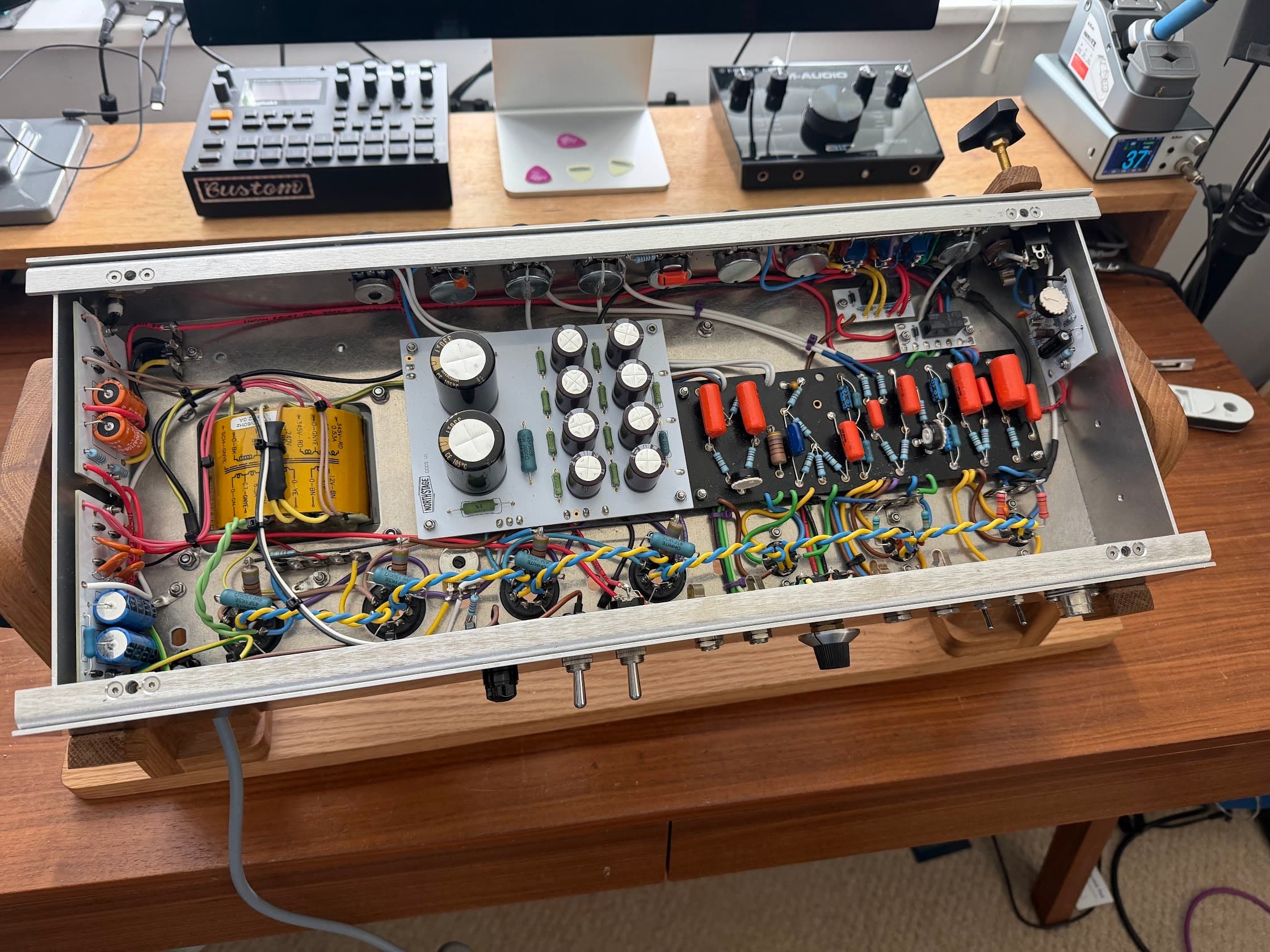
Dumble amplifiers occupy a unique place in the world of guitar. They are as much myth as they are machine – rare, obsessively refined, and deeply personal creations. For as long as I’ve been learning how thermionic valves really work, I’ve had one long-term goal in mind: one day, build my own Dumble. This project is that goal, realised.
Chasing the Dumble #183
The build is inspired by the highly documented Overdrive Special #183, one of the rarer EL34-based examples. Rather than relying on existing schematics, I approached this the same way I approach all of my more involved builds — from first principles.
I gathered every photograph I could find, studied known schematics, and began reconstructing the circuit from the ground up. Alongside this, I ran breadboard tests for key elements such as relay switching and the FET input stage, refining my understanding of how the amp behaves in practice, not just on paper.
The end result is a schematic I believe to be more accurate than the commonly circulated versions, particularly in the finer details of switching logic and gain staging.
One small but satisfying detail was identifying the specific JFET type Dumble often used in the FET input section. These aren’t easy to come by, but I managed to source a small batch of NOS devices, enough to see me through a number of builds.
From Schematic to Physical Layout
With the schematic complete, I moved into layout reconstruction, carefully recreating the physical board in Adobe Illustrator using reference photography. As with all builds of this complexity, this stage involved repeated checking and re-checking — ensuring that both electrical intent and physical implementation aligned properly.
From there, I switched to Fusion to design the chassis.
Rather than adapting an off-the-shelf solution, I chose to have a fully custom chassis fabricated, designed specifically around this layout. This allowed complete control over transformer placement, control spacing, and internal geometry — all critical in an amp where lead dress and component positioning directly affect performance.
With the chassis defined, I could then design the enclosure around it.
Thoughtful Deviations
Although this is a faithful recreation at heart, I made a few intentional changes.
The original #183 runs EL34s, but for this build I chose KT77s. They retain much of the EL34 character but offer slightly more headroom and clarity at the edge of breakup, which better suits my own playing preferences.
Cosmetically, I opted for the earlier Dumble cabinet style with aluminium trim, rather than the later tolex shelf design used on #183. It’s a small change, but one that shifts the visual character in a way I’ve always preferred.
Unlike my ’64 Vibroverb build, where I made an effort to source original or period-correct components, this project uses my own curated list of trusted, high-quality parts — components I know and rely on from other builds. The goal here wasn’t historical replication for its own sake, but performance, reliability, and consistency.
The Build Process
Once all parts arrived, the real work began.
The Overdrive Special is an exceptionally complex amplifier, requiring a significant amount of wiring and meticulous attention to detail. Lead dress alone can make or break the performance of the amp, affecting noise, stability, and feel.
This was not a quick build. The first iteration took around six weeks, including the cabinet construction, with constant checks throughout the wiring process.
When it came to first power-up, I followed my usual stage-by-stage startup procedure — more NASA launch sequence than casual switch-on. Each section is verified independently, voltages checked, behaviour confirmed, before moving to the next stage. It’s a slow process, but it dramatically reduces the risk of damaging components in a circuit this intricate.
Eventually, the moment arrives where there’s nothing left to check and the guitar gets plugged in.
The Result
I’ve never had the privilege of playing an original Dumble, so direct comparison isn’t something I can claim. But what I can say is this:
This is an exceptional sounding amplifier.
The overdrive is smooth but articulate, with a huge amount of harmonic content and a note clarity that remains intact even as the amp is pushed. Perhaps more importantly, it is incredibly touch-sensitive — responding instantly to pick attack and dynamics in a way that encourages you to play, rather than fight the instrument.
It feels alive in the way the very best valve amplifiers do.
A Personal Milestone
More than anything, this build represents a milestone in my own understanding — of valve circuits, of layout, and of the subtle interplay between design and feel.
It’s also the reason Dumble’s work continues to be so respected. These amplifiers aren’t just engineered; they are voiced, refined, and deeply considered systems, where every small decision contributes to the whole.
This is my take on that philosophy.