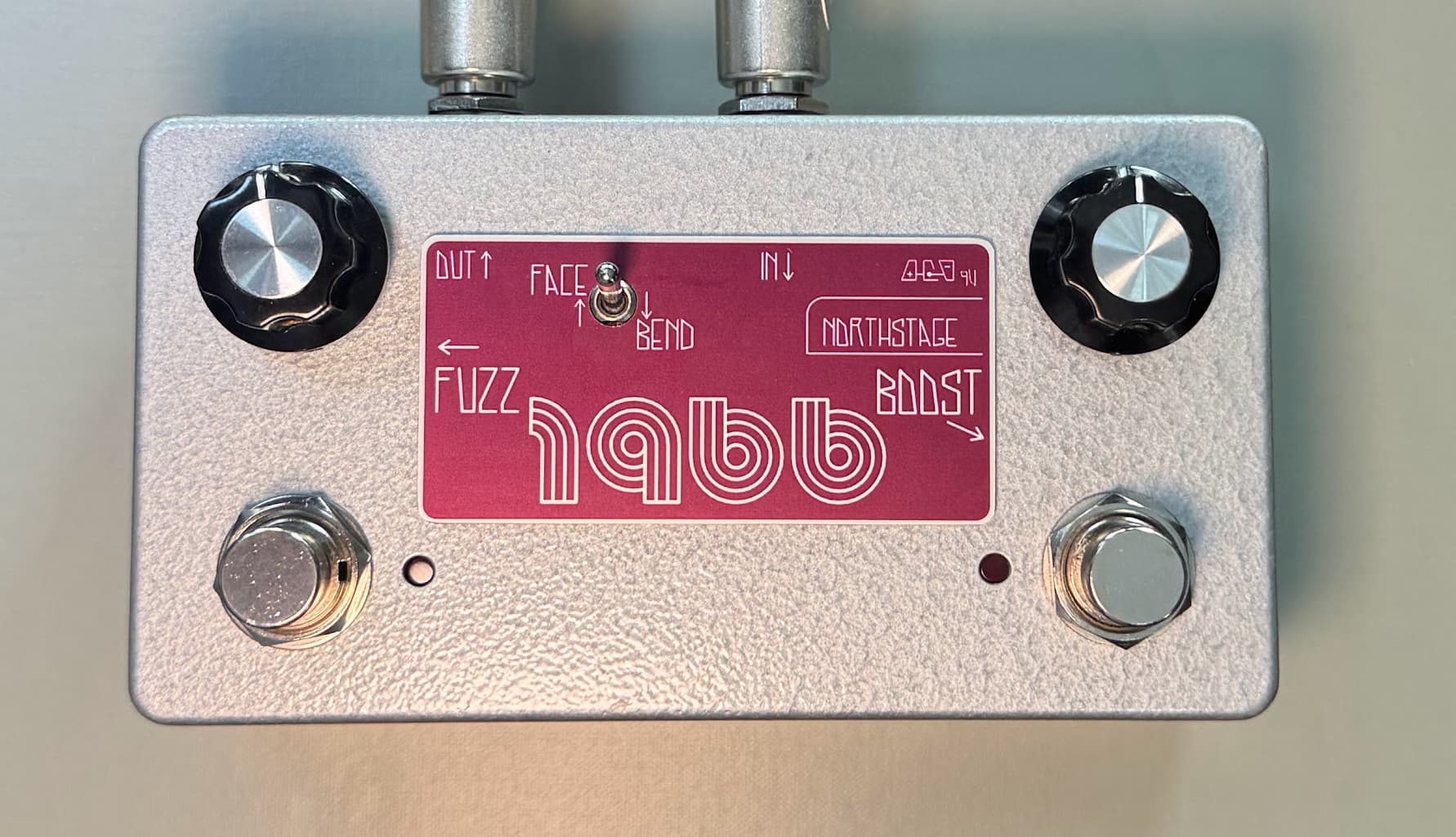
Fuzz Face or Tone Bender
I've always wanted to build the perfect fuzz pedal, but the first problem I run into was "is my favourite Fuzz a Fuzz Face or Tone Bender?" Both have moments where they're untouchable, and moments where you wish you had the other one plugged in. However, The day I sat down to analyse the Tone Bender schematic, I realised the two share enough common ground that a single switchable circuit was possible, and the 1966 idea was born.
The "perfect fuzz" conversation usually lands in germanium territory, but the player who knew Fuzz Faces better than anyone — Hendrix — chose silicon. That gave me a fresh problem, "Can I get silicon to sound like germanium?" Spoiler alert, yes, but the experimentation took a long time.
Transistor audition
First stage was finding a suitable transistor, germanium typically has a lower transconductance than silicon, so I started experimenting with low output silicon transistors. Next was getting the bias correct, but bias wasn't enough on its own. I then started experimenting with how the power supply feeds the circuit, deliberately raising the source impedance to drop Q2's headroom so compression sets in earlier. That's where the sag lives, the ultra-compressed, just-about-to-splutter quality of a really good sounding Fuzz.
The original Fuzz Face has a darkness to it that I wanted to keep, but not be stuck with. The Rangemaster was the obvious answer — period-correct treble boost for lifting the top end when the song asks for it. This needed further modification to play nicely with the rest of the circuit on a shared negative-ground supply, but once it was integrated, it gave me exactly what I was after.
Fixing the noise floor
The original prototypes was noisier than I wanted. A fair chunk of the development time after that went into driving the noise floor down — layout, grounding, and a couple of addiotnal capacitors here and there, until the pedal was as quiet at idle as a circuit of this kind reasonably gets.
What does it sound like?
Honestly, the best fuzz pedal I've played. It's deeply impedance-sensitive, so it responds to the guitar's volume knob like an analogue instrument: cleaning up beautifully as you roll the volume back, dirtier and fuller as you push in. With the Tone Bender switch engaged it pushes it up another notch. The fuzz is full and saturated but the still retain clarity of the notes you're playing, sitting right on the edge of splutter without ever falling in.