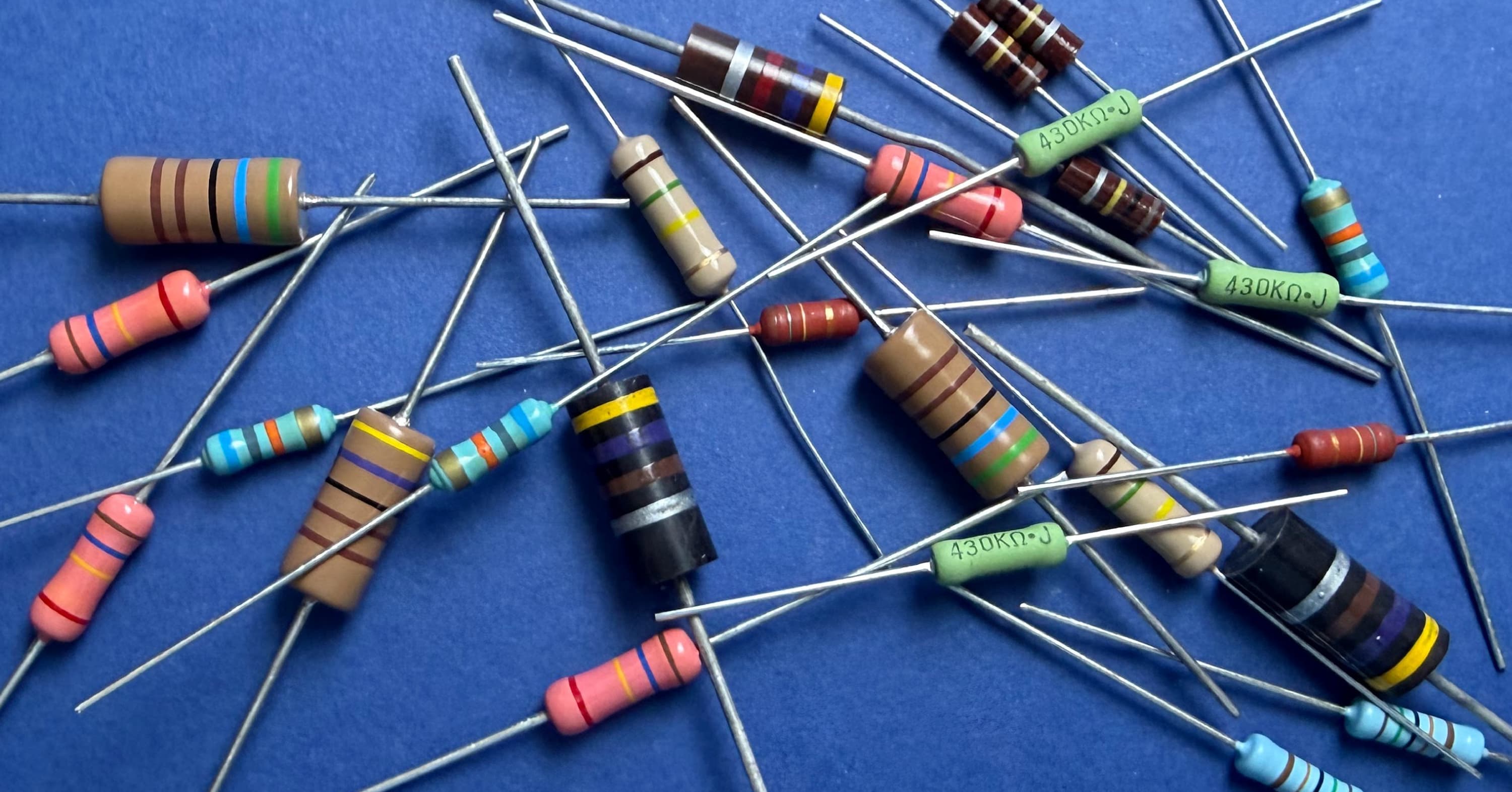
The mojo myth
There's a persistent belief in the valve amp world that carbon composition resistors carry some kind of magical tonal property or "Mojo". Drop a few into a build and the amp will sing in a way no modern resistor can match. It's a lovely story, and like most lovely stories about old gear, it has a small grain of truth wrapped in a great deal of folklore.
The grain of truth is real. Carbon comp resistors have what's called a voltage coefficient of resistance — their value changes very slightly with the voltage across them. With a big DC offset and a large signal swing, that creates a small amount of second harmonic distortion, which us guitarist find exceptionally pleasing. R.G. Keen's article on geofex.com (http://www.geofex.com/article_folders/carbon_comp/carboncomp.htm) lays out the maths properly and is well worth a read if you want the full picture. The short version: you only get a meaningful effect where you have both high DC voltage — think 200V plus — and a large signal swing across the resistor. That rules out almost every position in a typical amp.
Right tool for the job
It also rules in everything carbon comp is bad at: excess noise, drift with heat and humidity, and a habit of getting noisier as the years pass. Put them everywhere and you don't get more mojo, you get hiss, thermal drift, and an amp that needs work in five years for reasons that have nothing to do with the valves. So in my amps the default is metal film. They're quiet, stable, hold their value, and where the signal voltages are too small for any voltage coefficient effect to matter — which is most places — they're simply the better part.
The grid stopper
There's one notable exception: the grid stopper. That little resistor sitting right on the valve's grid pin isn't there to set a bias point or do anything tonal. Its job is to damp parasitic RF oscillations and to take the hit when the grid is driven positive and starts drawing current. Here I use carbon film. They're essentially non-inductive at the frequencies involved, they shrug off brief overloads better than metal film — which can crack internally and go noisy after repeated abuse — and when they do eventually fail they tend to fail open, which protects the valve. They're also far quieter and more stable than carbon comp, so you get the non-inductive behaviour the old designs relied on, without the drift and hiss.
That's really the whole philosophy: pick the part that does the job, not the part with the most romance attached to it. The amps I build use metal film almost everywhere, carbon film where it earns its place, and carbon comp essentially nowhere. The result is quieter, more reliable, and — to my ears, and the ears of the people who play them — every bit as musical as the vintage circuits they descend from.